
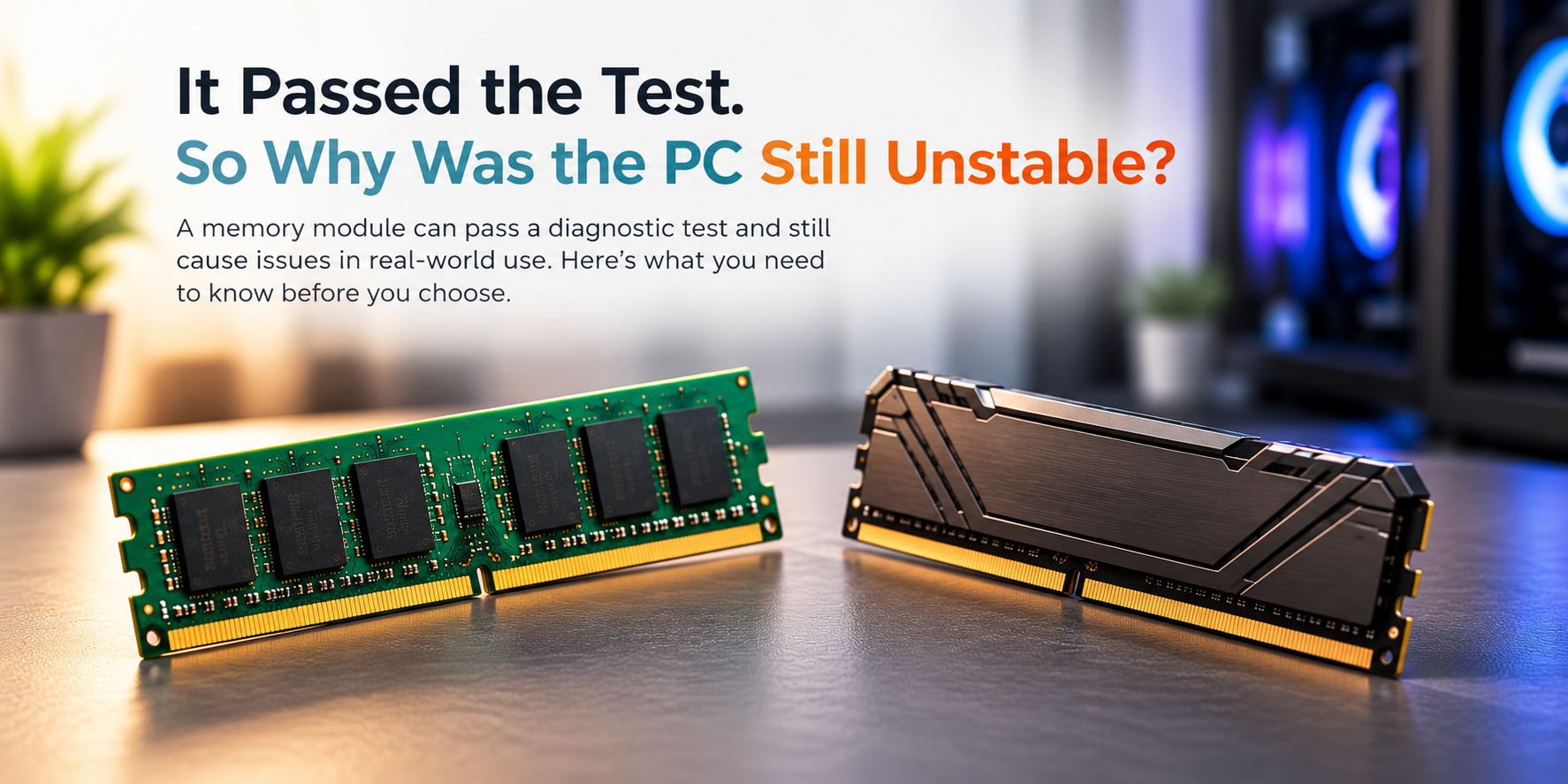
A component may look perfect on paper, but real-world performance can tell a different story.
When choosing components for a new PC, we naturally compare specifications, brands and prices. And quite often, the lower-priced option looks equally capable.
But here’s something worth understanding:
Two memory modules with similar specifications may not behave identically in every system.
1. What We Experienced During Testing
During one of our PC builds, we encountered an interesting situation.
The installed memory passed its diagnostic test without reporting errors. On paper, everything appeared fine.
However, the system continued to experience stability issues.
After further troubleshooting, we tried a different memory module from another manufacturer. The system subsequently operated normally during our testing.
This experience reminded us of something important:
A successful test is valuable evidence, but it isn’t a guarantee of perfect compatibility or stability under every condition.
2. Why Testing Is So Important
At guru shree computers, we believe that assembling a PC and testing a PC are two different responsibilities.
Testing helps us identify potential issues before the system reaches the customer.
A proper testing process may involve:
- Memory diagnostics and stability checks.
- CPU and GPU stress testing.
- Temperature and cooling verification.
- Compatibility and firmware checks.
- Testing under workloads similar to the customer’s actual usage.
Even after these checks, some problems may appear only under specific conditions or after extended use.
That’s why testing isn’t just a formality. It’s part of building a dependable system.
3. Good Specifications Don’t Always Guarantee Good Results
A memory module may offer the expected capacity, speed and specifications at an attractive price.
But specifications alone don’t tell the complete story.
Compatibility with the motherboard, CPU memory controller, firmware, memory settings and the quality of the individual module can all influence stability.
A basic memory module without a heatsink isn’t automatically inferior, just as a premium-looking module with a heatsink isn’t automatically more reliable.
What matters is whether the component works consistently in the intended system.
Sometimes, a component that appears suitable on paper simply doesn’t deliver the expected results in a particular configuration.
4. Be Open to What Testing Reveals
Nobody likes unexpected changes, especially after choosing a PC within a planned budget.
But imagine this:
You’ve selected a component, the quotation is finalized, and the system is being assembled.
During testing, an issue appears that wasn’t obvious from the specifications.
Your PC builder investigates and recommends a different component to improve reliability.
Naturally, you may wonder:
“Why should I change something I’ve already selected?”
That’s a fair question.
But the purpose of testing is to discover these concerns before they become your everyday problem.
A recommendation to change a component should be supported by a clear explanation of what was observed, what was tested and why the alternative is being suggested.
Sometimes, accepting the results of testing is more valuable than holding on to the original specification.
5. Trust the Process, Not Just the Price
A quotation shows the components and their prices.
It cannot guarantee that every component combination will behave perfectly under every workload.
When a builder identifies an issue, investigates it and recommends an alternative, that recommendation deserves consideration.
Of course, trust should work both ways.
The customer deserves transparency, and the builder must explain the problem, the available solutions and any additional costs.
6. Acknowledge the Work Behind a Reliable PC
A finished PC may look like a collection of components inside a cabinet.
But behind a properly tested system are hours of assembly, configuration, diagnostics, troubleshooting and verification.
Sometimes, the most valuable work happens when something doesn’t perform as expected.
Identifying an issue before delivery can prevent inconvenience and downtime later.
It’s worth recognizing that effort, just as it’s important for a builder to acknowledge the customer’s budget and expectations.
A reliable PC is the result of good components, careful testing and shared understanding.
7. When a Different Component Is Recommended
There may be situations where the original component needs to be replaced with a different, more suitable option.
That alternative might cost more. It might also cost the same or less.
The important question isn’t simply:
“Why is the price changing?”
It’s:
“What problem does this change solve, and how will it benefit my system?”
A responsible PC builder should explain the reason, provide the available options and obtain the customer’s agreement before making a chargeable change.
At the same time, customers should understand that an unforeseen compatibility issue does not automatically mean the builder was careless or misleading.
Likewise, an unexpected issue doesn’t automatically make the customer responsible for additional costs. That depends on the cause, warranty obligations and what was agreed.
The fairest approach is to evaluate the issue together rather than immediately assigning blame.
A better component recommendation should be judged by its technical justification, not merely by its price difference.
8. A Small Request to Every PC Buyer
Before making your final decision, remember:
- Ask questions. Understand why a particular component is recommended.
- Value testing. A passing result is useful, but it doesn’t eliminate every possible issue.
- Stay open to alternatives. Sometimes a different component is better suited to your system.
- Discuss costs transparently. Understand any price difference before approving a change.
- Respect the process. Good troubleshooting takes time, patience and technical effort.
The goal should never be to prove that the customer or the PC builder was wrong.
The goal is to get the system right.
Final Thoughts
At guru shree computers, we believe that building a PC is more than selecting components and putting them together.
It’s about understanding the customer’s requirements, choosing suitable hardware, testing carefully and communicating openly when something needs attention.
We understand that budgets matter. So do reliability, compatibility and peace of mind.
When unexpected issues arise, the best results come from customers and builders working together, with clear explanations, reasonable expectations and mutual trust.
Because ultimately:
The right PC isn’t simply the one that looks good on paper or comes at the lowest price.
It’s the one that works reliably for what you need it to do.
guru shree computers — Know Better. Build Smarter.
Leave a Reply
You must be logged in to post a comment.